
No products in the cart.
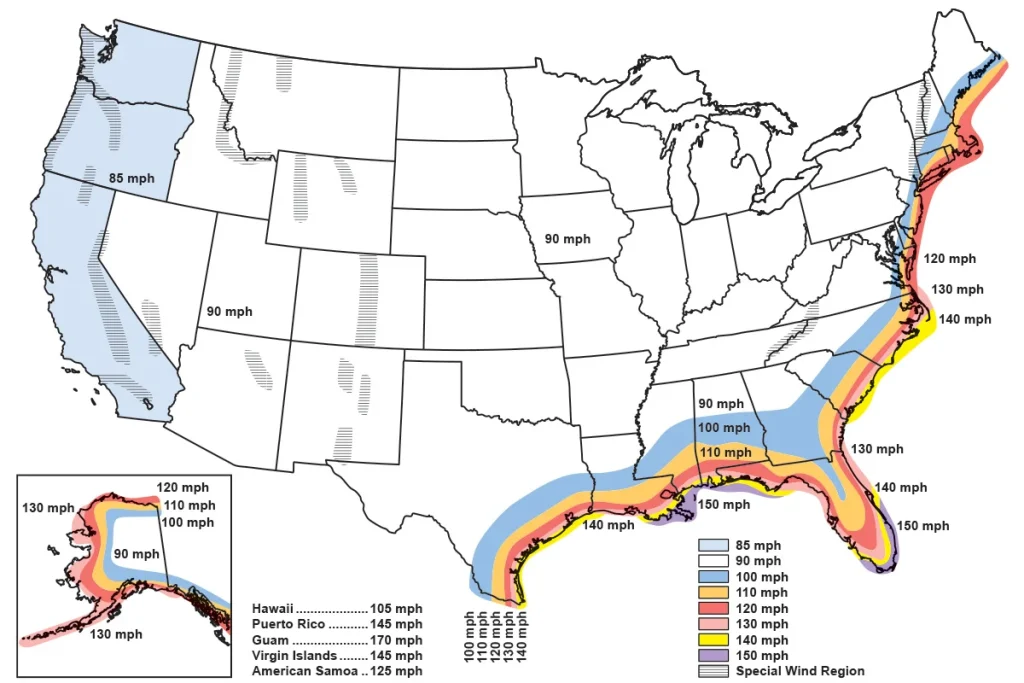
The map above shows the maximum steady wind expected at an elevation of thirty feet above ground level within a fifty-year period of recurrence. Areas with the same maximum constant or steady wind speed are indicated.
Safe flagpole design requires knowledege of the loads to which they will be subjected. Prinicpal load acting on flagpoles is wind load and that load must be carefully determined.
Maximum wind speeds to which flagpoles are exposed are dependent upon many factors such as Maximum wind speeds to which flagpoles are exposed are dependent upon many factors such as geographical location, whether or not it is in the center of a large city, a small town’s outskirts, seashore, at ground level or on the roof of a high building.
Wind speeds generally are higher along coastal areas than inland. They are also higher in open country than in the center of cities. Wind speed also becomes greater as height above ground increases. Wind exerts a force on the pole as well as the flag, thus both loads must be added to determine total load. Flags of different sizes are designed to be flown from different poles.
FLAGPOLES & WIND RATINGS
It’s important that flagpoles be selected which are capable of supporting the largest flag intended to be flown in the highest wind speed to which it will be subjected. Loads on flagpoles are resisted by the mounting foundation, roof, or wall to which it is secured. All flagpole design calculations are in accordance with guide specifications for design loads of metal flagpoles, ASNI/NAAMM FL1001-07 Fifth Ed.
The chart below has organzied our flagpole models by their max flagged wind speed rating to help you feel confident when selecting a flagpole for purchase.
| * Not all flagpole models maybe available for purchase on the website. If you cannot find what you are looking for please call: 208-615-5878 | |